Glass vs plastic containers is a choice every small kitchen owner makes. Limited cabinet and refrigerator space means choosing the right system matters. Wrong choice leads to stained containers, missing lids, and wasted space.
This glass vs plastic containers comparison covers what matters for apartment living: durability, storage efficiency, safety, and whether each option justifies the space it takes. Based on testing from Consumer Reports and Wirecutter.
Contents
- 1 Glass vs Plastic Containers: Quick Comparison
- 2 Glass vs Plastic Containers: Glass Pros and Cons
- 3 Glass vs Plastic Containers: Plastic Pros and Cons
- 4 Glass vs Plastic Containers: For Small Kitchen Storage
- 5 Glass vs Plastic Containers: Health and Safety
- 6 Glass vs Plastic Containers: Our Recommendation
- 7 Glass vs Plastic Containers: Maintenance Tips
- 8 Container Organization Tips
Glass vs Plastic Containers: Quick Comparison
| Factor | Glass | Plastic |
|---|---|---|
| Weight | Heavy | Light |
| Price | Higher ($25-50 for set) | Lower ($15-30 for set) |
| Stain resistance | Excellent | Poor (tomato, curry stain) |
| Odor resistance | Excellent | Poor (absorbs smells) |
| Microwave safe | Yes | Sometimes (check label) |
| Oven safe | Yes (most) | No |
| Freezer safe | Yes (if tempered) | Yes |
| Dishwasher safe | Yes | Top rack only |
| Durability | Can break if dropped | Durable but degrades |
| Lifespan | 10+ years | 2-5 years |
| Stacking | Good (rigid) | Good (lightweight) |
| Nesting (empty) | Limited | Excellent |
Glass vs Plastic Containers: Glass Pros and Cons
Glass Pros
No staining: Tomato sauce, curry, beets, nothing stains glass. Containers look new for years.
No odor absorption: Glass does not absorb food smells. No garlic ghost haunting your next meal.
Oven and microwave safe: Reheat directly in the container. No need to transfer to a plate.
Chemical-free: No concerns about BPA, phthalates, or plasticizers leaching into food.
Longevity: Quality glass containers last 10+ years with proper care. Better long-term value.
Easy cleaning: Stains wipe off. Dishwasher safe on any rack.
See contents clearly: Glass is truly clear. No clouding over time.
Glass Cons
Weight: Glass containers are significantly heavier. A filled glass container can be awkward to handle.
Breakable: Drop it and it shatters. Not ideal for clumsy moments or kids.
Lid issues: Most glass containers have plastic lids, which can warp or crack. The lid often fails before the container.
Higher cost: Initial investment is 2-3 times more than plastic sets.
Limited nesting: Empty glass containers do not nest as efficiently as plastic. Take more storage space.
Thermal shock risk: Extreme temperature changes (freezer to oven) can crack glass.
Glass vs Plastic Containers: Plastic Pros and Cons
Plastic Pros
Lightweight: Easy to carry, especially for packed lunches and meal prep.
Durable (impact): Drop it and it bounces. No shattered glass to clean.
Affordable: Lower initial cost. Easier to replace when needed.
Better nesting: Empty containers stack inside each other. Efficient storage.
Variety: More size and shape options available.
Kid-friendly: Safe for children to handle.
Plastic Cons
Staining: Tomato sauce, turmeric, and curry permanently discolor plastic.
Odor retention: Garlic, onion, and strong foods leave lasting smells.
Warping: Heat from microwave or dishwasher can warp plastic over time.
Degradation: Plastic becomes cloudy, scratched, and less effective over time.
Chemical concerns: Older or low-quality plastics may leach chemicals. Look for BPA-free labels.
Shorter lifespan: Expect 2-5 years before replacement needed.
Microwave limitations: Not all plastic is microwave safe. Must check each container.
Glass vs Plastic Containers: For Small Kitchen Storage
Space Efficiency
Plastic wins for empty storage: Plastic containers nest inside each other. A 10-piece set stores in the footprint of 2-3 containers.
Glass is rigid: Empty glass containers do not nest. They take the same space empty or full.
Solution for glass: Choose a set with compatible sizes that stack well when full.
Refrigerator Space
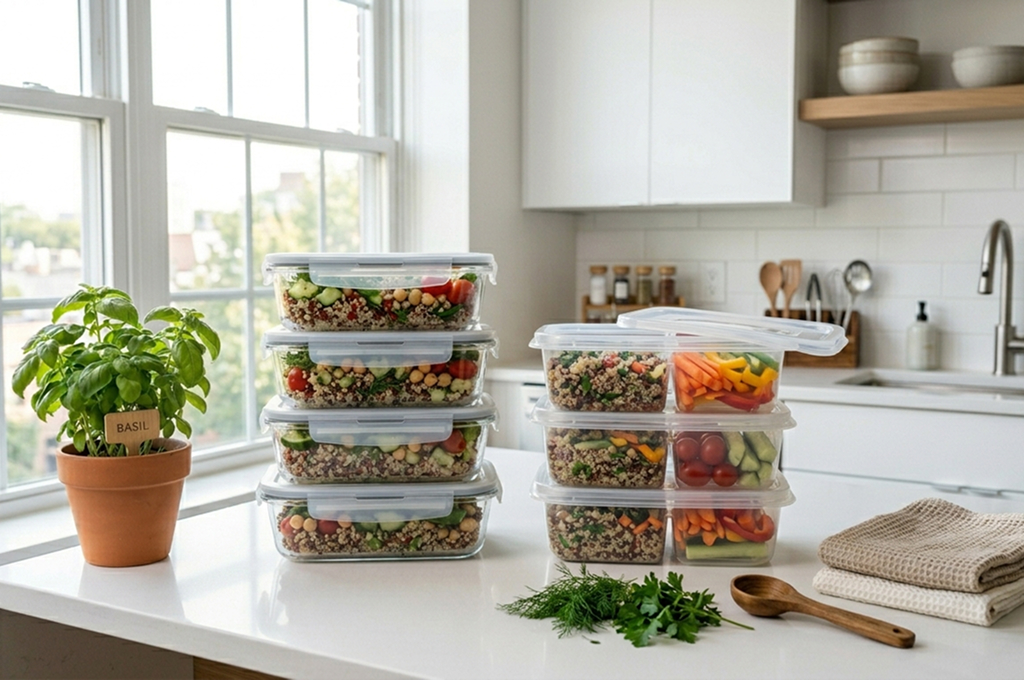
Both stack similarly when full. Choose squared corners over round for maximum fridge efficiency.
Glass advantage: See contents clearly through sides and bottom. Less “mystery container” opening.
Weight Consideration
For meal prep and transport: Plastic is significantly lighter. Multiple glass containers in a bag become heavy.
For home storage only: Weight matters less if containers stay in the fridge.
Glass vs Plastic Containers: Health and Safety
Microwave Safety
Glass: Safe for microwave reheating. No chemical leaching concerns.
Plastic: Only microwave-safe plastic should be used. Even “safe” plastic can degrade over time with repeated heating.
According to Harvard Health, avoiding microwaving plastic is the safest approach.
Food Contact
Glass: Inert material. Nothing leaches into food.
Plastic: BPA-free is the minimum standard. Some studies raise concerns about BPA replacements. Choose reputable brands.
Dishwasher Impact
Glass: Fully dishwasher safe. No degradation from heat.
Plastic: Top rack only. Hot water and detergent accelerate plastic degradation.
Glass vs Plastic Containers: Our Recommendation
For Most Small Apartment Kitchens: Glass
Glass wins on longevity, food safety, and long-term value. The higher initial cost pays off over years of use.
Best glass container set features:
- Snap-lock lids (not clip lids that break)
- Rectangular shape (stacks efficiently)
- Multiple sizes (2-cup, 4-cup, 6-cup)
- Oven and microwave safe
- Tempered glass (freezer safe)
Cost: $25-45 for a quality set
When Plastic Makes Sense
Choose plastic if:
- You transport meals daily (weight matters)
- You have young children (drop-proof)
- Budget is tight
- You need maximum nesting for storage
If choosing plastic, invest in quality BPA-free sets from reputable brands.
Cost: $15-30 for a quality set
The Hybrid Approach
Best of both worlds:
- Glass for home storage and reheating
- Plastic for packed lunches and transport
- Silicone collapsible for space savings
This covers all use cases without compromise.
Glass vs Plastic Containers: Maintenance Tips
Glass Care
- Allow to cool before washing (prevents thermal shock)
- Replace lids when they crack or warp
- Check for chips before use (can cause cracks)
- Store with lids off to prevent odor buildup
Plastic Care
- Hand wash to extend lifespan
- Do not microwave (transfer to plate)
- Replace when stained, warped, or smelly
- Store with lids off
Container Organization Tips
The One-Drawer Rule
Keep all containers in one drawer or cabinet section. If they overflow, you have too many.
Lid Storage
Option 1: Store each container with its lid on Option 2: Store lids in a separate bin, organized by size Option 3: Use a door-mounted lid organizer
Cost: $10-20
Regular Purge
Every 6 months:
- Discard cracked, warped, or stained containers
- Match lids to containers (discard orphans)
- Limit total inventory to what you actually use
Related:
- Meal Prep Containers for Small Kitchens
- Small Fridge Organization Ideas
- Kitchen Cabinet Organization Ideas
This post contains affiliate links. See our disclosure for details.