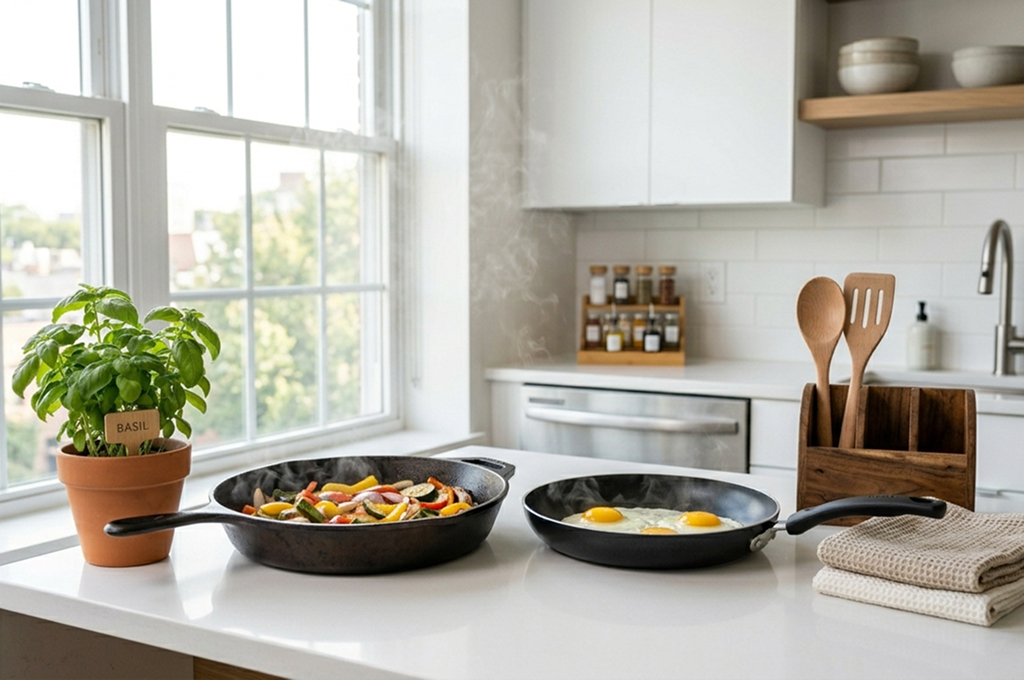
Cast iron vs nonstick pan is a debate every small kitchen owner faces. Limited cabinet space means choosing wisely. You cannot keep every pan, so which one earns its spot?
This cast iron vs nonstick pan comparison covers what matters for apartment living: versatility, maintenance, storage, and whether each pan justifies its space. Based on testing from America’s Test Kitchen and Serious Eats.
Contents
- 1 Cast Iron vs Nonstick Pan: Quick Comparison
- 2 Cast Iron vs Nonstick Pan: Cast Iron Pros and Cons
- 3 Cast Iron vs Nonstick Pan: Nonstick Pros and Cons
- 4 Cast Iron vs Nonstick Pan: Best Uses
- 5 Cast Iron vs Nonstick Pan: For Small Apartment Kitchens
- 6 Cast Iron vs Nonstick Pan: Our Recommendation
- 7 Cast Iron vs Nonstick Pan: Care Tips
Cast Iron vs Nonstick Pan: Quick Comparison
| Factor | Cast Iron | Nonstick |
|---|---|---|
| Weight | Heavy (5-8 lbs) | Light (2-3 lbs) |
| Price | $20-40 (lasts decades) | $20-60 (replace every 3-5 years) |
| Heat retention | Excellent | Poor to moderate |
| Oven safe | Yes (any temp) | Limited (usually under 450°F) |
| Stovetop to oven | Yes | Sometimes |
| Maintenance | Seasoning required | Easy cleanup |
| Lifespan | Lifetime | 3-5 years |
| Versatility | High | Moderate |
| Best for | Searing, baking, high heat | Eggs, delicate fish, low-fat cooking |
Cast Iron vs Nonstick Pan: Cast Iron Pros and Cons
Cast Iron Pros
Versatility: Cast iron goes from stovetop to oven to broiler. Sear a steak, bake cornbread, make a frittata, all in one pan.
Heat retention: Once hot, cast iron stays hot. Perfect for searing meat with a good crust.
Durability: A cast iron pan lasts generations. Your grandmother’s pan still works perfectly.
Natural nonstick: Well-seasoned cast iron becomes naturally nonstick over time. No chemical coatings.
Value: A $25 Lodge skillet performs comparably to $200 pans for many tasks.
Improves with use: Cast iron gets better the more you cook with it.
Cast Iron Cons
Weight: A 12-inch cast iron skillet weighs 7-8 pounds. Not easy to maneuver, especially for one-handed cooking.
Maintenance: Requires seasoning. Cannot soak in water. Needs drying immediately to prevent rust.
Heat distribution: Heats unevenly. Hot spots develop, especially on electric stoves.
Reactive with acid: Tomato sauces and wine can strip seasoning and add metallic flavor.
Slow to heat: Takes longer to preheat than other materials.
Storage: Heavy and cannot be stacked easily without protection.
Cast Iron vs Nonstick Pan: Nonstick Pros and Cons
Nonstick Pros
Easy release: Eggs slide out. Pancakes flip effortlessly. Delicate fish stays intact.
Low-fat cooking: Use minimal oil. Food does not stick even with light coating.
Easy cleanup: Most food wipes off with a paper towel. Minimal scrubbing.
Lightweight: Easy to lift and maneuver. Good for one-handed cooking.
Fast heating: Heats quickly and evenly on most stovetops.
Beginner-friendly: Hard to mess up cooking when food does not stick.
Nonstick Cons
Limited lifespan: Coating degrades over 3-5 years even with careful use. Then you must replace.
Temperature limits: Most nonstick coatings cannot handle high heat (above 450-500°F). Overheating can release fumes.
No oven versatility: Many nonstick pans have plastic handles that cannot go in the oven.
Poor searing: Does not get hot enough for proper meat searing with good browning.
Fragile coating: Metal utensils scratch the surface. Dishwasher damages coating.
Not for deglazing: Cannot build fond (browned bits) for pan sauces.
Cast Iron vs Nonstick Pan: Best Uses
When Cast Iron Wins
- Searing steaks, chops, and burgers
- Pan-roasting chicken
- Baking cornbread and skillet cookies
- Making frittatas and Dutch babies
- High-heat cooking
- Oven-to-table serving
- Any recipe requiring stovetop-to-oven transition
When Nonstick Wins
- Eggs (scrambled, fried, omelets)
- Pancakes and crepes
- Delicate fish (sole, tilapia, flounder)
- Reheating leftovers
- Low-fat cooking
- Quick weeknight meals where easy cleanup matters
Cast Iron vs Nonstick Pan: For Small Apartment Kitchens
Space Consideration
Cast iron: One pan does many jobs. A 10 or 12-inch skillet can replace a baking dish, serving dish, and searing pan. Fewer pans needed overall.
Nonstick: Lighter and easier to store. Can stack with other pans using a protector. Better for cabinets with limited depth.
Maintenance Reality
Cast iron: In a small apartment with limited drying space, cast iron requires immediate drying to prevent rust. Not ideal if you leave dishes in the sink.
Nonstick: Rinse and done. No special care. Fits busy lifestyles better.
Cooking Style Match
Choose cast iron if: You cook steaks, bake, value durability over convenience, and do not mind the weight.
Choose nonstick if: You cook eggs daily, prefer easy cleanup, do limited high-heat cooking, and want lightweight pans.
Cast Iron vs Nonstick Pan: Our Recommendation
For Most Small Apartment Kitchens: Start with Nonstick
A quality nonstick pan handles 70% of everyday cooking with minimal hassle. Start here.
Recommended: 10-inch nonstick skillet for 1-2 people, 12-inch for cooking larger batches.
Cost: $30-60 for a quality pan
Add Cast Iron Second
Once you have a nonstick pan, add a cast iron skillet for searing and oven tasks. A 10-inch size is manageable weight.
Cost: $20-35
The Two-Pan Kitchen
For minimal setups, these two pans cover nearly everything:
- 10-12 inch nonstick (daily cooking, eggs, easy meals)
- 10-12 inch cast iron (searing, baking, high heat)
Total investment: $50-95. Covers 95% of cooking needs.
Cast Iron vs Nonstick Pan: Care Tips
Cast Iron Care
- Dry immediately after washing
- Apply thin oil layer after each use
- Store in dry place
- Use silicone or wooden utensils
Nonstick Care
- Hand wash only (no dishwasher)
- Use silicone, wooden, or plastic utensils (no metal)
- Do not overheat empty pan
- Replace when coating scratches or food starts sticking
Related:
- Compact Blender vs Food Processor
- Air Fryer vs Toaster Oven for Small Apartments
- Best Countertop Appliances for Small Kitchens
This post contains affiliate links. See our disclosure for details.